Buy, Build or Wait: AI for Market Access Teams
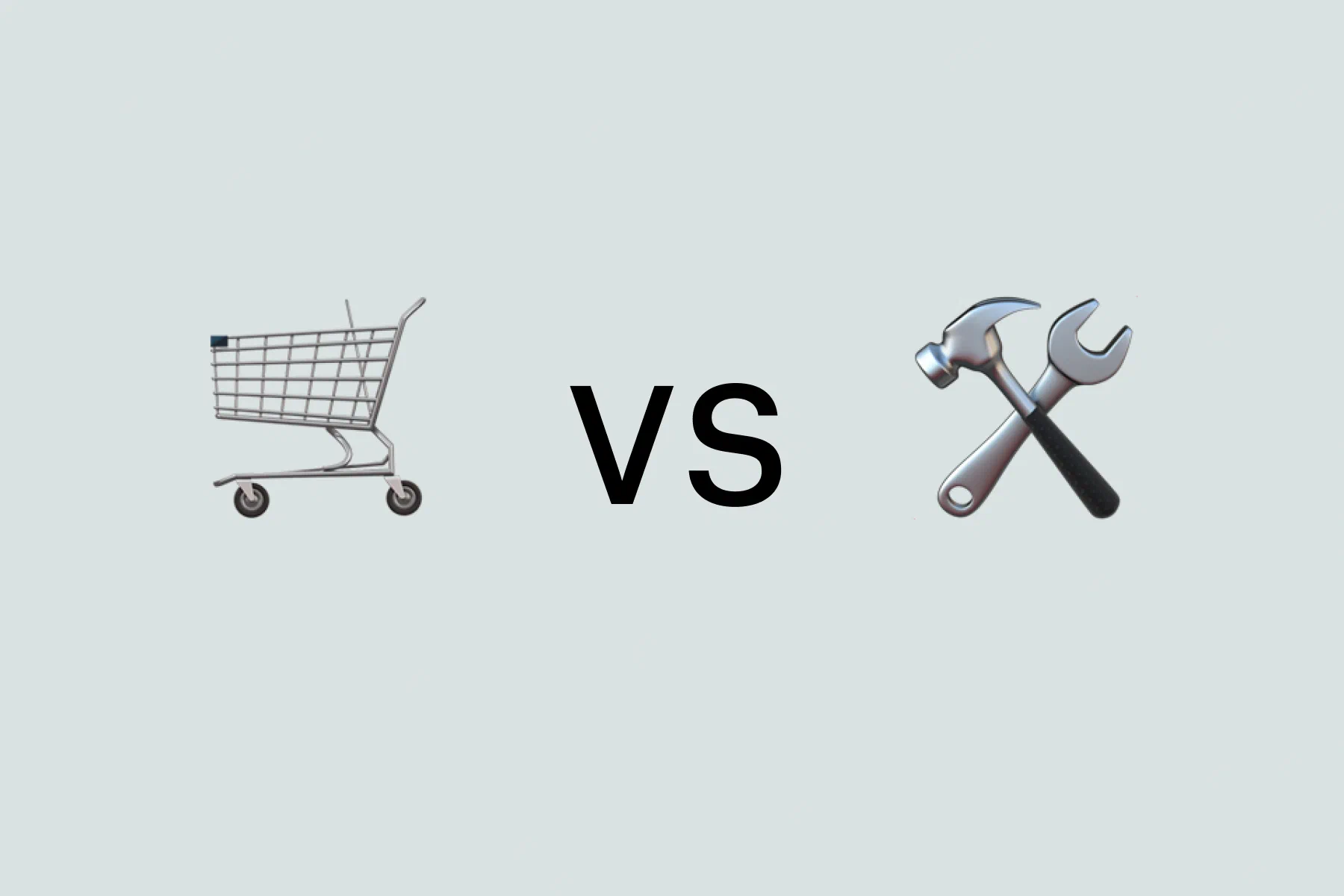
At the World EPA Congress 2026, every talk on AI essentially asked the same question: how can we get it to work, faster? One of the most recurring themes was buy-vs-build. As market access and pricing teams move past the “prompting age” and frustrating chatbots, they face a choice. Buy better tools from a vendor, build them internally, or build with the help of an external partner.
In the context of AI transformation and elsewhere, buy-vs-build has been much discussed. The standard dimensions of the decision rubric apply here as well. However, the specifics of market access and pricing matter, as they shape the answer of the buy-vs-build question in unusual ways.
The standard heuristic, briefly
Let’s start by revisiting the classic “build-what-is-core, buy-what-is-non-core”-heuristic. In a nutshell, four trade-offs structure the decision.
Strategic focus. Custom AI development consumes senior management attention and scarce talent. Build only where there is a real strategic rationale. Broad programmes, which almost inevitably overemphasise quick-wins, often lead to ‘pilot purgatory’.
Total cost. Off-the-shelf is cheaper because vendors amortise development, operations, compliance and support across many customers; internal builds are the most expensive, partner-supported development sits in between.
Speed and agility. Off-the-shelf offers a fast path to ROI when integration effort is contained, but switching costs can later cut the other way; conversely, vendor trials can help to validate a use case before committing to a tailored development.
Control and IP. Build preserves full confidentiality and the path to a proprietary asset, but only if what is built is genuinely unique and strategy-aligned; buy or partner can be a fast route to outside know-how.
How market access and pricing is different
The MA&P industry has four distinct characteristics that matter for buy-vs-build.
The work. A market access team handles two kinds of task side by side, often within the same week and the same person. One is high-volume and largely standardised: localising dossiers, answering tender questionnaires, running structured literature reviews, drafting first-pass objection responses, producing payer briefing documents. The other is intellectually demanding, experience-intensive and judgement-led: the right comparator for a Phase 3 design, the launch sequence across markets, the structure of a managed-entry agreement in a hold-out market, the response to a payer objection that could not have been anticipated. The first kind is about throughput (efficiency), and the gain from AI is measured in hours saved. The second is about the answer itself — whether the comparator chosen now will still be accepted by HTA bodies in three years, whether the price corridor holds against a switch. The value of getting it right is immense, and the cost of AI negligible. Both categories of use cases need to be evaluated separately, not in a single 2x2. Worth noting: MA&P is highly unusal in that there actually are AI applications that affect the P&L.
The data and the stakes. Much of what makes a market access team effective relies on information that does not leave the company: the history of payer objections built up over years of negotiation, the confidential pricing strategy, the read of payer sentiment in a given market, the actual standard of care in a particular indication, the history of HEOR models and their QA. A vendor does not have any of this. The only outsiders who might are direct competitors and, maybe, a small set of large service providers. In this situation, confidentiality is critical: a query like “how do we defend the price corridor on compound X if the comparator switches?” is not the kind of data that should leak into a vendor’s logs. Moreover, modern AI systems get better with use, which means the team using a vendor’s tool is helping the vendor’s tool — fine for a commodity workflow, less so for a strategic one. And every tool carries a subtle bias. What if the competition uses the same tools? Taken together, this shifts the balance away from off-the-shelf tools.
The market structure. Fragmentation in MA&P does not come from technical silos or organisational quirks. It comes from disease biology and from national differences in policy, payer culture and institutions. This is the reason the field sustains a cottage industry of specialist advisors, each focused on a slice of geography or therapeutic area. The same force puts a low ceiling on the addressable market for any non-commodity software product. A vendor trying to build a tool for, say, neuromuscular disease access in the Nordics has neither the customer base nor the data to do it well at a price the market would bear. Scaling is hard. Rather than a plethora of specialised off-the-shelf tools, what is more likely to emerge are general middleware platforms on top of which MA&P teams build their own logic.
The teams. Market access and pricing teams are unusual in their composition: scientifically trained, quantitatively literate, internally trusted with sensitive material, and used to working with abstract methodology. Three things follow. For simple automation, they can build things themselves, with Microsoft Copilot, Claude or enterprise automation platforms. For complex AI applications, they are the ideal counterpart for a co-development effort: the methodology can be designed and tested together, and the prototype need not be polished or failsafe to be useful. And unlike most other corporate functions, they are not the people whose jobs AI threatens. As Lydia Frick put it at EPA 2026, “let robots do the boring work.” Active engagement, rather than quiet resistance, is the baseline, which makes the co-development model work. This is why MA&P teams are structurally well positioned to develop sophisticated AI instruments that leverage their know-how.
Working it through
What does this mean concretely? Below, a look at use cases discussed at EPA 2026. The reasoning matters more than the verdict, as software vendors are moving fast.
Tender questionnaires. The task is firmly on the commodity side: the same questionnaires move between teams, the format is structured, and no piece of proprietary insight is at stake on any single response. The data is largely public or already shared with the payer. Vendor products in this space are competent today and improving.
Dossier localisation into smaller-language markets. This is an awkward case. The need is acute — teams covering smaller markets often lack in-house language expertise, and a working tool would help most where models work least. Foundation models perform worse on those languages because their training data is sparse, and the vendor product market does not yet target them. For the moment: do this by hand or team up with a local consulting company for a co-development (or managed service), if volume justifies it. Revisit in a year.
PICO scoping prediction. This is the strategic tier. The PICO defines the evidence base, the evidence base shapes the JCA, and the JCA sets the price — a wrong decision costs much more than any AI development ever could. A usable tool needs a curated evidence base, transparent reasoning that lets experts intervene mid-way, and the discipline to stop and flag uncertainty when the evidence runs out. A companion article on tovorafenib walks through what off-the-shelf models miss here. There is no vendor route into this work: the data is private, the reasoning has to be auditable, and no one outside pharma has the precedent to draw on. Build, but expand the scope in small steps.
HEOR model QC. A vendor product here would have to be trained on a corpus of historical HEOR models broad enough to know what good and bad look like across indications. That corpus does not exist outside pharma firewalls and HTA bodies, and is not likely to be assembled. The realistic configuration is a checking engine built on top of public guidelines — NICE’s checklist is the obvious starting point — and the team’s own historical model library. Build, if volume justifies it.
The same exercise, more briefly, on other workflows that came up at EPA 2026:
- Major-language dossier localisation. Commodity work in well-resourced languages; solid off-the-shelf products will emerge.
- AI-assisted SLR. The retrieval engine is a commodity, but the way a team frames the evidence for its own asset is not. Buy the retrieval part, build the customisation layer on top.
- HTA and FDA question simulation. A simple tool over the team’s dossier corpus is something a competent group can ship in weeks.
- Payer negotiation training. Avatar-based platforms work and are improving. The country-by-country and payer-by-payer fine-tuning happens through the vendor’s training hooks rather than requiring you to own the platform. Buy.
- AMNOG outcome prediction. No-one has cracked this, and progress depends on reading proprietary G-BA precedent that no outsider has. Build, but only when a team has the attention and resources to take it on seriously.
Several of these will look differently in just a few months, as vendors close gaps and technology matures.
Conclusion
The cases above fall into two categories. For non-differentiating commodity workflows, the standard buy-vs-build logic applies and off-the-shelf usually wins. For the strategic tier, it does not. The reasons run through this article: vendors lack what it takes to build a product, hyper-fragmented markets work against SaaS business models and exceedingly high stakes make confidentiality and biases inherited from external tools real concerns. The decision is build or wait.
But is waiting wise? For most corporate functions, AI saves hours. For MA&P teams, it affects outcomes that move the P&L. By the time a market access team gets to work, most of a drug’s development cost is sunk; what remains is recovering it.
In a few years, the likely scenario is that proprietary AI has become table stakes: an analytical infrastructure no team can do without. Which makes the EPA 2026 question — how to get AI to work, faster — the one that matters. The time is now: as AI models improve with use, those who start early and improve consistently can quickly build a headstart that becomes hard to catch up.
In my experience, the single most important success factor is getting co-development right. This needs sustained time and attention from the MA&P team, and an AI team, internal or external, that not only understands the industry but wants to be in the room with the people doing the work. The teams that pull this off will work from insights the competition can’t match, and a tool that gets better every month.