“Pathology foundation models enable us to build more scalable pipelines for our team but also for our product”
Pathology slides contain vast biological information, but much of their interpretation remains manual. aignostics is developing foundation models and AI-powered products to turn this data into insights for biomarker discovery, target identification, and digital diagnostics. We spoke with Max Alber, Co-founder and CTO of aignostics, following his talk at the idalab Seminar in Berlin about the pathology foundation models, the company’s roadmap, and lessons from building aignostics.
This conversation has been lightly edited for clarity.
What was the original vision behind the company?
Two of my co-founders, Klaus-Robert Müller (Professor of Machine Learning at TU Berlin) and Frederick Klauschen (at the time Professor at Charité – Universitätsmedizin Berlin), started the journey about sixteen years ago.
Klaus’ brother-in-law had just died of cancer and he wanted to improve the way cancer care is practiced.
Frederick, on the other hand, is a pathologist. He had an idea of what the future of pathology should look like and was looking for collaborators when he met Klaus.
They began validating their ideas and, after several years of scientific work at Charité, received grants to establish the company.
When aignostics was formally established in 2020, Viktor Matyas (now CEO at aignostics) and I joined as operational founders. Viktor’s focus is on the business and operational side, and I focus on technical development.
How is aignostics using foundation models?
What matters most for us is the strong feature representation of these foundation models, which allows us to build our products more efficiently.
When we recently launched ATLAS H&E TME, which profiles the tumor microenvironment and immune responses from H&E images, we also saw that the foundation model allowed us to scale across cancer indications much faster and with better quality.
Early experiments showed that we could reduce the amount of supervised annotations we need by roughly a factor of ten, which is a significant difference.
In many cases, the models also generalized to indications where we had never collected any supervised data at all, which was also very encouraging.
Beyond that, foundation models help across the entire machine learning workflows, such as better clustering of images and improved image retrieval.
Generally, pathology foundation models enable us to build more scalable pipelines for our team but also for our product.
You partnered with external institutions on these foundation models. Can you talk about the collaboration and what each side contributed?
Sure.
In these collaborations, we bring in our expertise on how to build foundation models and, importantly, how to benchmark and evaluate them properly. That’s something we’ve developed internally over time.
Our main partner, the Mayo Clinic, contributes high-quality data sets and partially training runs on their computer infrastructure.
To bring AI solutions into hospitals and labs, regulation is a key piece of the puzzle. How does aignostics navigate the regulatory landscape?
We have had a ISO 13485 quality management system in place since the first year of the company. At the beginning, that was a lot of overhead, but now it really pays off because we feel very well prepared for all regulatory requirements.
ISO 13485 is the standard for building medical devices. We apply this not only to our products, but also to our foundation model development processes. That means among other things we have regulatory-grade documentation in place for all these tools.
So while the foundation model itself is not a medical product, it can be integrated into medical products. Having this level of documentation makes it much easier for partners to build on top of it in a compliant way.
In terms of regulation, IVDR is the next step on our roadmap. So far, this hasn’t been critical for our pharma customers, as research use in clinical trials was usually the focus. But everything we build is dual-use by design.
While we currently focus on pharma for business reasons, we absolutely plan to move into the clinical space in the long run.
As aignostics grows, what are the next big milestones you’re focusing on?
Launching ATLAS was a major milestone for us and we’re already working with nearly half of the world’s top 20 pharma companies, which is a big achievement in itself.
The next challenge is scaling our products. That means completing the offering in terms of indications and features and making sure the product fully delivers on what our partners need.
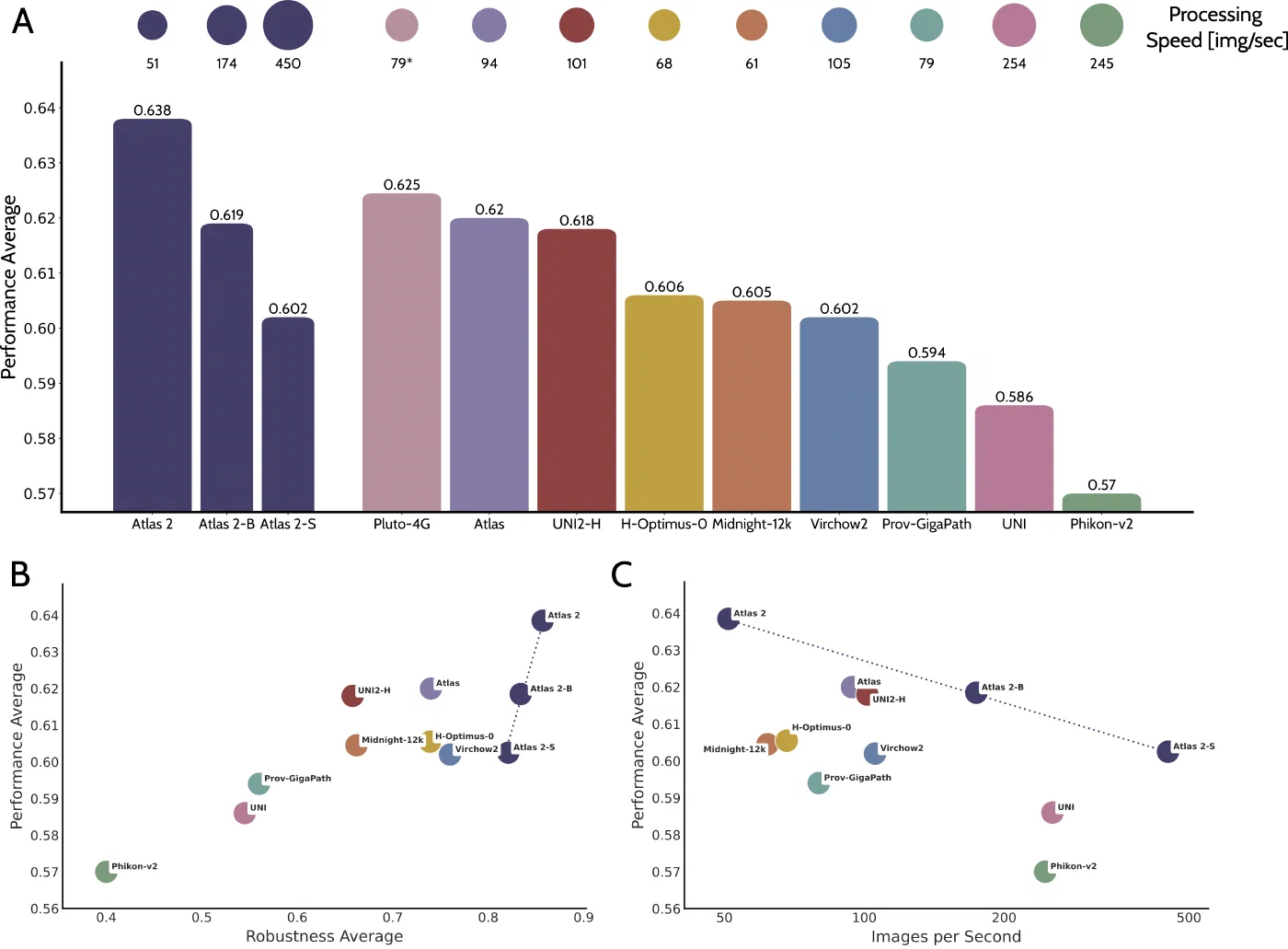
In parallel, we are preparing the launch of ATLAS 2, which will be the next version of our foundation model, planned for January 2026 [Editor’s note: ATLAS 2 was published on January 8, 2026].
Overall, everything we are doing right now is centered around product advancement and improving the underlying foundation models that power it.
Any advice for future founders who want to enter this field?
First, talk to experienced founders and learn from them, or bring experienced founders onto your team.
Also, domain expertise is obviously important in healthcare and biology, but operational and management expertise are just as critical. Startup operations are often similar across industries, and this is frequently underestimated.
Without strong operations and leadership, you will not be able to navigate the complexity of pharma and healthcare.
Max, thank you for this fascinating conversation.
My pleasure.
References
- Alber, M., Milbich, T., Carpen-Amarie, A., Tietz, S., Dippel, J., Muttenthaler, L., Perez Cancer, B. et al., 2026. Atlas 2-Foundation models for clinical deployment. arXiv preprint, arXiv:2601.05148.